
RATTLE SNACK
- Jul 8, 2025
- 3 min read
Tavishi
Growing up in Arizona, I've gotten to see my fair share of rattlesnakes:
My Nana (maternal grandfather) and I are always on the lookout for snakes. When the roads heat during summer, we get to see more and more snakes come out. It's fun when they're alive, but upsetting when they are not. Unfortunately, we've lately gotten to see more dead snakes than alive snakes.
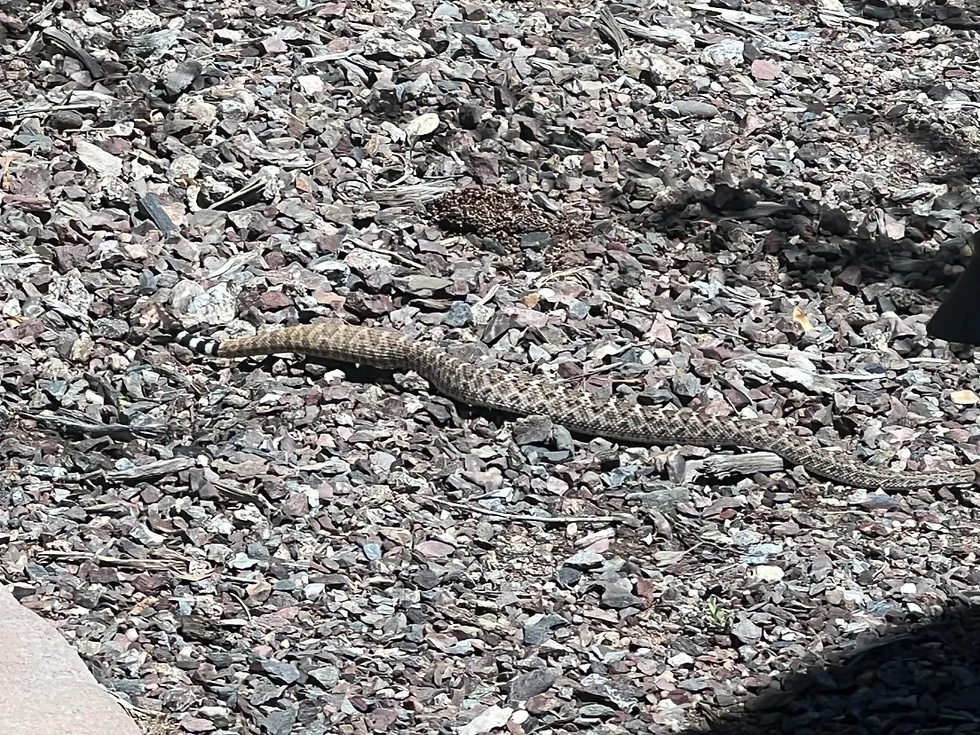
I think my favorite rattlesnake sighting, by far, was during April 22, 2020. I was enjoying my sixth grade backyard pond view, when all of a sudden, I spotted a snake. I whipped out my laptop camera as fast as I could, and managed to get this on camera:
Rattlesnakes will always remind me of my Nana, who is right now, very sick. What better way to cope with grief than to throw all my passion into science?
First, we take upon ourselves the duty of defining a rattlesnake. Contrary to popular belief, rattlesnake is not a species. Instead, there are 36 species of rattlesnakes, with vast morphological differences across the board.

Taxonomically, all rattlesnakes are considered vipers because they all belong to the subfamily Crotalinae, consisting of all the pit vipers. If we were to use the analogy of first cousins, this is the cool, blue-haired, older cousin of the rattlesnake:

Anyways, all rattlesnakes belong to two genuses: Crotalus and Sistrurus. Now, you may think a defining characteristic of rattlesnakes is a rattle at the end of the tail. If so, you're wrong: four species of rattlesnakes have tendency towards having no rattle. Most prominently is the Santa Catalina rattlesnake, or C. catalinensis. The Santa Catalina rattlesnake has very few natural predators, and so, the rattle's sound became a burden to it when hunting, rather than advantage when being hunted. As a result, the snek evolved to not be able to keep the rattle on when shedding.

Other cool fact about rattlesnakes: they're ovoviviparous. Essentially, instead of laying eggs that hatch, the snake holds the eggs inside their bodies until the eggs hatch. When the little baby snakes emerge from their eggs, their mothers give birth to them.

Also, some rattlesnakes even have parental care, a concept virtually unheard of in snakes. It's fairly common in mammals, but not really in reptiles.
Yet another cool thing: BRUMATION! Brumation is just like low-grade hibernation; similar concept, less physiological slowing down. Rattlesnakes spend the winters in these massive underground dens, shared with a lot of other snakes and even other animals.

As you can tell, the missiles are very skeegy.
By far, physiologically, the coolest part of the rattlesnake is their heat-sensing pits. I love extra sensory adaptations: most notably, vibrissae in pinnipeds. But the pit organs in rattlesnakes? Surefire way to get me excited. They are so hypersensitive, and attuned perfectly to noticing the presence of a threat like a coyote in the nearby surroundings.

Pit organs are located along the lip line, just below the nostrils in snreekeees, and are little innervated air-filled pits (hence the name). The nerve responsible for this sensation? The trigeminal nerve, which you might remember from my post on cranial nerves.. https://www.kradigan.org/post/cranial-nerves
(shameless plug)
Interestingly enough, these infrared sensations are processed in the head of sekeknreos in the optic tectum, which, as you might imagine, processes mostly visual information. If you think about it, these snakes are sorta seeing heat. And that's really cool to me.
The receptor cells that relay information to the trigeminal nerve, later relaying information to the optic tectum via the nucleus reticularus caloris. But in the receptor cells, the actual propagated signal is produced by a matter of ions. A temperature sensitive ion channel, TRPA1, actually is what causes the snakes to sense all of this. I think that is very cool.
(p.s. I am so all over the place in this post I'm sorry I'm just in yappy mode)


Comments