
DEEP SEA SHARKS
- Dec 2, 2025
- 4 min read
Tavishi
When I tell someone I'm interested in marine biology, the general assumption is that I love warm-water tropical animals. While I do love a good turtle or dolphin, my interest is piqued more by cold-water strange animals.
When it comes to pinnipeds, I'm especially fascinated by the Antarctic species, or the lobodontine seals, including the crabeater, leopard, Weddell, and ross seals.
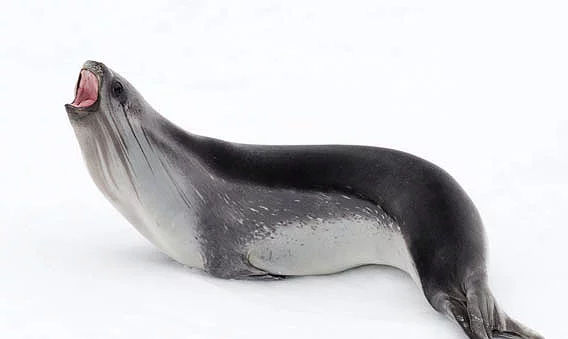
Unfortunately for me, this means if my future follows my goals, I'm going to live in the most miserable weather possible for the rest of my life.
I am very fond of animals that are so well adapted to their environments that they are so unbelievably ugly:

[insert smooth segue into deepwater sharks]
I just want to talk about sharks, and this is MY blog, so no one can stop me.

Goblin sharks are so oddly shaped and so ugly, and so I love them dearly. It doesn't really swim as much as? drift and float around hungrily. Deep water sharks tend to skulk rather than charge forth, because they don't really need to be fast swimmers if there's no light surrounding them (wow descent with modification evolution crazy work). Whereas shallow water and open ocean sharks tend to have a forked tail, deepwater sharks are more primitive and tend to have less symmetry. That symmetrical forked tail is associated with faster swimming speeds, whereas the asymmetrical tail of a goblin shark is more associated with... skulking.

Goblin sharks are also known for their absolutely unhinged jaw. Their jaws are, quite literally, unhinged. They shoot their jaw out to catch prey.
Shark jaws are very differently structured than mammalian or human jaws. Whereas mammalian skeletons are formed from bone, shark skeletons are formed entirely from cartilage. The jaw of the goblin shark is loosely attached by a few ligaments, in comparison to the tight temporomandibular joint in humans and mammals.
When feeding, the goblin shark shoots its jaw out, lowering its basihyal mouth surface and expanding its pharynx to create suction- essentially, it turns its mouth into a vacuum.

Because goblin sharks live in dark conditions and also don't really actively move towards their prey, they need some way to detect food surrounding. As with many other low-light animals (see Devil's pupfish), goblin sharks have lowkey useless eyes. They do, however, have an unsightly and ugly protruding "nose" called a rostrum. Their rostrum is full of these things called ampullae of lorenzini, which are these special sensory receptors that detect electricity. I feel like I've definitely written about these in a post before, because I freaking love these receptors.
The concept of an electrically active rostrum is exactly why paddlefish are maybe my favorite fish species ever (very similar to the goblin fish in nose appearance, lol.)

Another ugly ahh deep water shark that I love is the ever-famous Greenland shark. The Greenland shark is best known for its ridiculously long life, living up to 500 years, and potentially even more. As mentioned earlier, deep water sharks tend to be longer living, more primitive, and skulkier in their very way of life than shallow water sharks.
And just like the unsightliness of the goblin shark, the huge freaking Greenland shark (they are approximately 16 cats standing head to tail long), are soaked in urine.

Dramatics aside, the Greenland shark's tissues have a startlingly high concentration of urea and trimethylamine N-oxide, which help the Greenland sharks cope with the hyperosmotic, high pressure water conditions. Also, because just like the goblin shark, the Greenland shark doesn't swim much, but rather just floats and broods about, which necessitates buoyancy that is promoted by urea and trimethylamine N-oxide.

Another mechanism by which buoyancy is maintained in broody deep water sharks is a larger liver size, as can be seen in the goblin shark.
Another fun little deep sea shark order is the Hexanchiformes, or the sixgill, sevengill, and frilled sharks. Most shark species not in this group have 5 gill slits, but all Hexanchiform sharks have six or seven gills (hence the names). Just like the goblin shark, these sharks also are poor swimmers with asymmetrical caudal fins.
A select few members of this order are the frilled shark and the sharpnose seven gill shark.
The frilled shark has a long, undulating, eel-like tail, and is known to have one of the longest gestation periods of any vertebrate, at 2-3.5 years. This shark is oviviparous, meaning it has eggs inside it which hatch, but the eggs hatch within the mother.

The sharpnose seven gill shark has maxxed out its gill amount, and has a black tip on its dorsal and caudal fins (bro is trying SO HARD TO BE A BLACKTIP REEF SHARK..)

Anyways, just like the goblin shark, all hexanchiforms have an abnormally large and fatty liver, in addition to a bad-for-swimming-asymmetrical-tail. Deep water sharks do their absolute best to be brooding emo losers, and it works pretty well.


Americans will use anything but the metric system.