
PARALLELOGRAMS IN YOUR BLOOD!
Tavishi
I was talking to my friend Russell about what I'm thinking about writing about for Kradigan this week and mentioned wanting to write about thrombus and embolism formation. In response to this, Russell said, "oh, like the shapes with the parallel sides?" Apparently, Russell was trying to troll me, because he then insisted that rhombuses are not parallelograms. Fun fact: rhombuses are definitionally parallelograms. Russell has forgotten math (as a MATH MAJOR).

First, this made me realize I haven't done a math post in a hot minute. I tagged this post as a math post for sillies, though. At some point, I will write a goofy post about all the ways I use calculus in my daily life as a student who will never take another math class again in their life. I will say though, I did do integrals during my class on glomerular filtration rate on Thursday.
Second, as far as I know, geometry is not invading your blood vessels.

What are invading your blood vessels? Quite a lot of things, actually.
For the purpose of this post, however, thrombuses. A thrombus is an aggregate mass formed in the lumen (inside) of a blood vessel, composed of blood tissues, like platelets, red blood cells, fibrin, etc. The issue with this? Uh. Blood needs to flow through the blood vessels, not thrombuses.

The process of thrombus formation is known as thrombosis.
Thrombosis is prompted by three major factors, known as Virchow's triad: endothelial damage, disordered blood flow, and hypercoagulability.
Damage to the endothelium, or the inner cell lining of a blood vessel is the most prominant cause or thrombosis within the heart and arteries. Endothelial damage can be caused either by issues with the cells themselves, or some other issue with what is flowing through the vessels. For example, high blood pressure can cause endothelial damage.
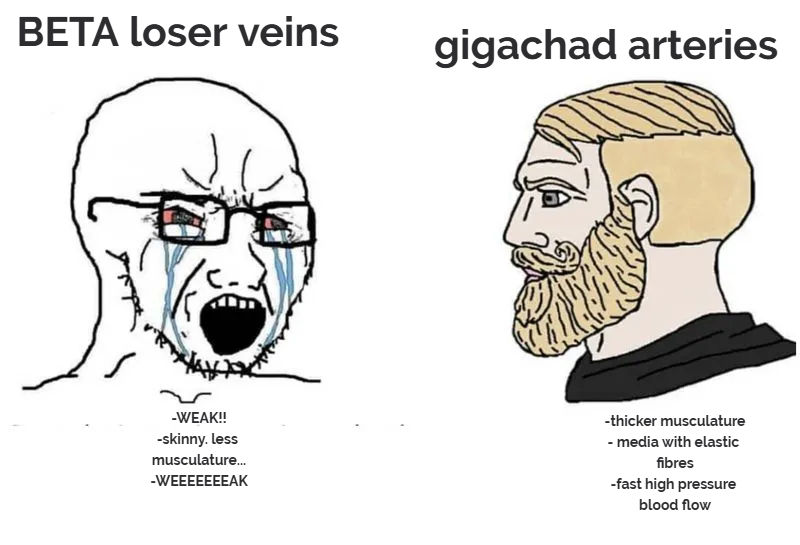
Another mechanism of thrombosis is disordered blood flow. This is generally responsible for thrombosis in veins and other low pressure vessels. Veins are the lowest pressure vessels in the body, and are driven mostly by gravity. As a result, veins are very slow-moving vessels as well. Because of this, veins tend to be built differently such that faster blood flow does not sit well with them, and are rather a lot floppier and less muscular than arteries.

sidebar 1: in our point-to-point practicals (release a cohort of students into a room with a bunch of cut up animals and make them identify things), one of my professors handed a group of us each a plastinated heart (I wrote a blog post about the process of plastination, go search through my past posts) and made us identify the aorta and vena cava based off of palpation of the vessels alone. The musculature and strength of arteries are very easily physically felt, which was something that was really cool to notice. Another time I noticed this was when I dissected a seal two weeks ago (I've now dissected TWO gray seals!). It's actually truly incredible to be able to feel, touch, and notice easily all the same things you can notice through a histological cross-section. I think some of the most magical moments in science are when you can apply your theoretical knowledge to practicum.
Ok back to what I was saying. Turbulent blood flow. Not good for weak little vessels!!
Finally, the last part of Virchow's triad is hypercoagulability. Hypercoagulability is either caused by inheritable or immediate factors. Inheritable causes of hypercoagulability include mutations on part of the clotting cascade, like on factor V or prothrombin. These commonly cause thrombosis in veins. Immediate causes of hypercoagulability include dehydration or disseminated carcinoma (spread of cancer of epithelial tissues throughout body).

Contrary to popular belief, thrombuses are not parallelograms, and I'm almost mathematically certain they cannot be parallelograms (does anyone want to challenge me on this???).
Thrombuses are, however, an aggregate of blood pieces.
In the case of an injury to vessel endothelium, thrombus begins to form when the body tries to heal aforementioned wound. Platelets accumulate at the site of injury, and start to cause the coagulation cascade (now can you understand how issues with the coagulation cascade cause thrombus formation?). The end goal of the coagulation cascade is to form a fibrin clot, when thrombin turns the zymogen fibrinogen into fibrin. Normally, this would result in wound healing and scar formation. In the case of thrombus formation, platelets instead get trapped in the fibrin, and an awful positive feedback loop ensues where the platelets attract more platelets, and other cell bits like erythrocytes get caught in the fibrin web.

Thrombus composition also tends to vary based off of location. Whereas venous thrombi tend to be much more heavy in fibrin and platelets, arteries, because of their faster blood flow, have a much more red blood cell heavy thrombus.
In histological samples, the deposition of fibrin and red blood cells is often visible, especially so in arterial thrombus samples. It's kind of like the deposition of tree rings, or Alyssa Liu's hair halos. These are called lines of Zahn. The darker bands are deposition of red blood cells, and the paler, more basophilic lines are fibrotic and platelet tissue.

Now that we have a thrombus, what do we do about it? The body either gets over it, adds it to the blood vessel (insanely crazy and goofy response btw), or it causes Problems™️.
Either the thrombus propagates, or grows along the length of a blood vessel, or it embolises, where bits of it, or even the whole chunk, breaks off and goes on a joyride around the body. When propagation gets bad, it tends to turn into embolisation.
Needless to say, embolism is bad because you don't want a huge chunk of Blood Goo causing issues around your blood vessels.

Two major pathologies resulting from this are pulmonary embolism and myocardial infarction. Pulmonary emboli generally result from venous thrombolism, especially deep vein thrombosis in the leg. Mural thrombi, or thrombi growing on the hearts of ventricles, can both form from and result in necrosis of cardiac tissue by blocking blood flow, causing a heart attack.
Medicine aims to intervene before it gets that far, though. Generally, in veterinary medicine, the goal is to do preventative care, which starats with keeping animals on a healthy diet, but can extend to just monitoring and preventing clot formation in the first place in animals prone to such issues (see: comorbid nephropathies, Horses).
sidebar 2: why is everything wrong with horses? They can't mouth breathe. OR VOMIT? they breathe so strangely. sorry, why are you just letting your lungs get pressed about by gravity? why are we failing to actively breathe when we run???? nightmare creatures. love them, though.
Unfortunately, treatment of embolism in animals is far behind treatment in humans, which is a really cool area of potential research and innovation... (psst. RVC do your thing).
In humans, though, non-surgical intervention of thrombosis includes administration of anticoagulant drugs and thrombolytic medication. Most common treatment includes heparin, an anticoagulant medication.
A very well known blood thinning medication is aspirin, which is why it should not be taken by people with prior clotting issues. Because that can cause a lot of worse very bad issues like strokes and the like. Which tends to be. bad and dangerous. (I hope this goes without saying. Strokes are bad for you).


Comments