
BIOLOGY OF BEING BUFF
Tavishi
I've developed a new hobby: weightlifting! It kinda started as a joke, but I've rapidly gotten really into going to the gym and bodybuilding this past month. I now go to the gym 4-5 days a week, and have like an actual routine. Good news; I've definitely gotten stronger, but I still have a long way to go. First thing I noticed is how as soon as I stop paying attention to my nutrition, my diet becomes woefully devoid of protein.
Lately, I've been legume and yogurt maxxing though, and that's been pretty cool! I'm branching and diversifying my recipes, too (how many times can one eat daal chawal?). Last week, I made a bunch of lentil and pickled cabbage wraps and they were so good. My favorite part is that they leak purple juice (see: cabbage).

Anyways, because I'm me, and am physically incapable of not wanting to understand the exact reasons I do what I do, I also have been reading a lot about the metabolic pathways of muscle growth and how going to the gym actually works.

The actual process of muscle growth is called muscle hypertrophy. The term hypertrophy refers to the process of growth of individual cells. Similarly, hyperplasia is the process of growth of amount of cells. There's also atrophy, which is a shrinking of individual cells. There's a lot of words that have to do with changes in size.
Getting buff, however, is associated with muscular hypertrophy.
First- basic skeletal muscle anatomy. Muscles are like Russian nesting dolls- it's bundles all the way down. Muscles are enclosed in a layer of connective tissue called epimysium. The muscle itself is split into muscle bundles, which are further split into fasiculi, each enclosed in a connective tissue layer called perimysium. The fasiculi are composed of thousands of muscle fibres, each enclosed in a layer called the endomysium. The muscle fibres consist of myofibrils, each of which consists of several sarcomeres, which are the basic functional contractile unit of muscle.

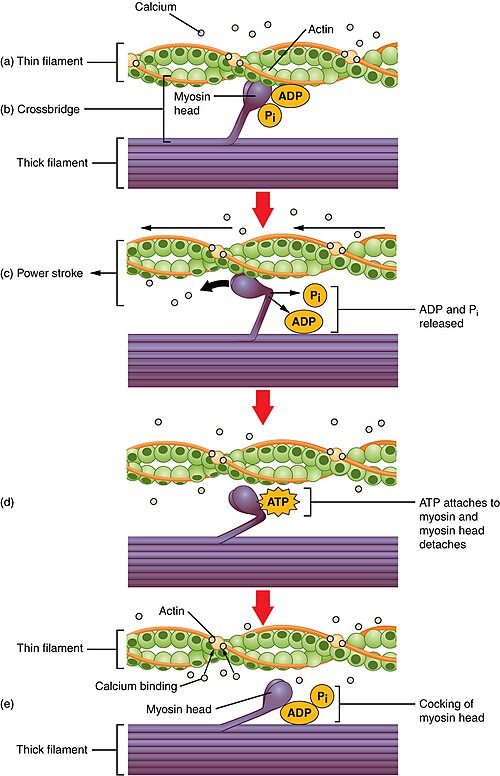
The sarcomere does something like this when contraction and relaxation happens:

Translated to words, two proteins are involved in muscle contraction- actin and myosin. There are binding zones on actin that are covered by tropomyosin. When calcium is released (there's a whole pathway I will be skipping because no one has attention span), binding sites on actin are uncovered, allowing myosin to bind to those sites, thus shortening the sarcomere.
The initial signal that induces muscle growth is muscular contraction against a load (translated to English, muscle contracting against a weight). Muscle contraction is classified here into three types: concentric, eccentric, and isometric.
Concentric contraction is associated with the shortening of a muscle; for example, bringing a weight up during a bicep curl. Eccentric contraction is associated with the lengthening of a muscle; for example, bringing a weight down during a bicep curl. Isometric contraction does not change the length of a muscle, but still brings tension, which is the sort of driving force between muscle growth. An example of an isometric contraction exercise is doing a plank; you're never actually moving your body, but your muscles are working to keep you in plank position.
There are two ways your body knows you're working out: either mechanical stress or the build up of metabolites related to exercise.
Mechanical receptors in muscles include integrin proteins and stretch-activated ion channels. These receptors are responsible for sensing tension, through interaction with a lot of other molecules.
Metabolic stress includes the buildup of lactate (see: anaerobic respiration), inorganic phosphate and other molecules associated with high-intensity exercise. These stressors are detected by a variety of mechanisms, including through increased osmosis into the cell.
Once the stress of working out has been detected in your muscles, several different pathways are activated. Of course, everything I say in this blog is superficial, and there are countless other mechanisms. The pathways I outline aren't the only ways muscle growth happens, but they are some of the important ways. It's also important to note that we as humans aren't super knowledgeable about if we even know all of the ways muscle growth happens. We don't really know what we don't know, nor how much we don't know, but that is the nature of science.
I'm yapping because I'm thoroughly tired.
Back to the topic at hand.
The major driving factor of muscle growth is protein synthesis. A major pathway implicated in protein synthesis in muscles is the Akt pathway.
The pathway begins with the binding of insulin-like growth factor 1, the synthesis of which is prompted by exercise, to IGF-1 receptor. IGF1R is a tyrosine kinase! Pretty cool type of membrane receptor.
Anyways, this PI3K, which in turn, activates AKT. AKT has a variety of functions, including joining in on the mTOR pathway, or activating the eukaryotic initiating factors, which are a group of proteins crucial to the process of translation (literally part of the key machinery of making proteins). They are often the rate-limiting crucial factors that make or break protein synthesis.
AKT also activates the mTOR pathway, which less directly activates protein synthesis. mTOR stands for mammalian target of rapamycin, and activates another EIF and also, p70s6k, which is again, a key component of the protein translation machinery. P70S6K promotes protein synthesis by adding a phosphate group to ribosomal protein s6, which is part of the small ribosomal subunit.

Ok I am exhausted good night KRdiagn


Comments