
HOW DOES PICKLING WORK?
Tavishi
I have been told I have three personality traits: pickles, pinnipeds, and metal. This is... moderately accurate (especially) if my personality is the t-shirts I have.
I have managed to accrue three different pickle t-shirts.

My love for the sour, salty, and fermented is a core tenet of who I am, and my refrigerator shelf. My flatmate (now former flatmate) Mary can vouch for this. We had a beach picnic once with other snacks but more importantly pickles and green olives. Incredible time. She also once got me a Costco sized jar of green olives (Mary, if you're reading this, I miss you and your olives). Also, on the topic of salty, Mary has the most incredible flaky sea salt jar that I used to steal flakes out of to eat (I'm sorry if this is how you find out, Mary).
Anyways. I love pickles. I especially love:
Kosher baby dills-> incredible crunch and sourness
Cornichons-> downside: French. Upside: tiny and crunchi
Kimchi-> spicy and crunchy cabbage AND sour. I love kimchi at its most fermented, when I can taste the bubbles
Pickled garlic-> I love garlic. I love salty. And this is the only complaint Mary ever had of me as a flatmate ever.
Capers/caperberries-> SALTY? Incredible little texture. Ideal bagel is caked in cream cheese, and further covered in capers. Not a centimetre of un-capered cream cheese should be visible.
Pimiento-stuffed green olives-> salty, and the little pimiento bit in the center is peak. or should i say. peak-le. (I'm sorry in advance for the jokes)
Aam ka achar (mango pickle)-> perfectly salty, and the texture of mango flesh when pickled is incredible
Pickling is a process born from necessity, that has been preserved throughout history. Prior to the invention of refrigeration, pickling was a way to keep food from spoiling, allowing produce to be enjoyed in different seasons. While the highly acidic, salty environments, kept food safe, it also made it very, very tasty.
Pickles are generally either fermented or unfermented.
Unfermented pickles are prepared in high salt concentration brines or vinegar brines. Fermented pickles are prepared in lower salt concentration brines, and generally involve the production of lactic acid by naturally occuring positive bacteria.
The way pickling preserves food is by creating highly acidic environments in which undesired microflora cannot grow.
For example:

Fun fact 1: botulism is bad for you.
C. botulinum is just one of the many risks of bad, at-home pickling. For example, pickling brines that are too high in pH. This is why pickle brines must be below 4.6 in pH to ensure proper preservation. Otherwise, you need to consume your pickle jar in a few days, and only refrigerate.
This is a major concern of salt unfermented pickles.
Botulinum toxin is produced by this bacteria, and is why botulism is bad for you.
Botulism toxin is a neurotoxin blocking the neuromuscular junction, preventing the release of acetylcholine from presynaptic neurons. Botulinum specifically cleaves SNARE proteins. The SNARE complex is composed of three proteins, synaptobrevin, syntaxin, and SNAP-25. Synaptobrevin binds to the vacuole containing acetylcholine, facilitating the release of acetylcholine into the synaptic cleft.
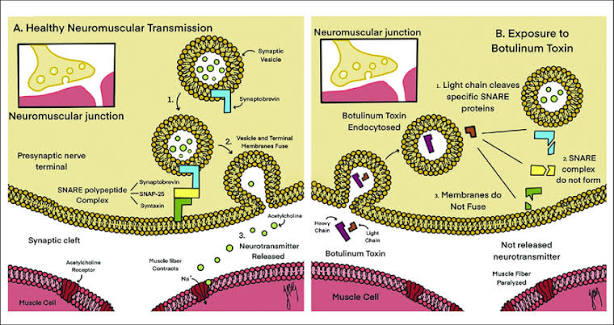
Normally, acetylcholine would stimulate muscles to do their muscley thing. When acetylcholine is not released, nerves are trying to get muscles to move, but to no avail. This results in muscle weakness, lethargy, and poor muscle tension.
Other pathogens which can thrive in unpreserved environments include bacteria like Listeria and Salmonella, and mold like Penicillum and Aspergillus.
Fun fact 2: I don't want mold poisoning.
Anyways, pickles prevent disease with high salt content (generally works to ward off mold by drawing water out of the vegetable) and high acidity. Acidity in pickles can be created by the pickler or the pickle. Some forms of pickling, like unfermented pickling, just straight up drop a cucumber in some vinegar, otherwise known as acetic acid. And this does work! Fermented pickling, however, relies on bacteria to grow in the environment and undergo the process of fermentation. Pickles are in anaerobic environments, which is key to their sterility. Fermentation is a method that allows organisms to produce ATP without oxygen.

Cellular respiration is the usual mechanism of generating ATP; you use oxygen and glucose, and get carbon dioxide, water, and ATP. But when you don't have oxygen, but still need ATP, cells undergo glycolysis exclusively to produce ATP. An important tool required for glycolysis, however, is NAD+. Fermentation tacks an extra process on after glycolysis to produce extra NAD+. The byproduct of fermentation creates the highly acidic environment the cucumbers crave. There are several types of fermentation, depending on what byproduct is produced. Lactic acid fermentation is the type of fermentation involved in pickling.
This lactic acid is produced by a few species of positive bacteria:
Lactobacillus plantarum
Lactobacillus brevis
Leuconostoc mesenteroides
LACTOBACILLUS SPP.
Lactobacillus spp. are some of the most dominating bacteria species found in pickles. They are known to tolerate higher temperatures and salt concentrations than Leucosnostoc spp.
These bacteria are traditionally found later in pickles later in the pickling process.
Not only do these species lower the pH of the environment, but their antimicrobial processes extend to the production of bacteriocins, which literally punch holes in bacterial cell walls or prevent them from forming. Lactobacillus spp. do not really care about us getting infected with C. botulinum, so their bacteriocin production is actually entirely unrelated to us. It is a helpful little tool, though!

LEUCONOSTOC SPP.
Leuconostoc species are typically less acid-resistant than lactobacillus. They are also heavily reliant on temperature, and are only facultative anaerobes.
Generally, this genus is less known for its probiotic effects.
Ultimately, there are a variety of probiotic bacterial species with varying effects on digestion, lowering blood cholesterol, and increasing immunity.
So what I'm hearing is that I'm not destroying my kidneys, I'm strengthening my body with my insane salt intake.
ok goob nite party pickles


clicked on todays post excited to be credited for the pickle shirt i gifted to not be credited :(