
SNIPPETS!
- Dec 15, 2025
- 5 min read
Tavishi
I have spent the last week agonizing over choosing a topic to write about in my Kradigan. I had too many ideas, and have learned about too much cool stuff. I love university; even when I feel like I've learned the content, it feels like there's always more to dig into. Going to a specialized animal school makes this sort of thing even worse, because there's just infinite possibilities to learn and explore my interests.
I learn and function like a corvid. I collect little baubles and trinkets, both metaphorically and literally. My windowsill is covered in goofy little morsels of pretty things I've picked up off the ground (see: bird feathers and? several 2p coins and little goofy things.) My brain, while it has also cohesively learned a bunch of things (that is how school works), I've also got a little mental charcuterie board of new fun facts and cool new things I dwell on.

My first night when I moved in, I saw a fox zipping about near the dumpsters near my accomodation, and was so excited. I soon came to learn that foxes are everywhere here. After late night study sessions, especially at the start of term, I'd go outside and just jump around and frolic in the leaf piles on the street outside the university. During these excursions, I would see the odd person, but more than anything, I was accompanied by the urban foxes.

I've learned that the best time to see foxes is past 11 PM and before 6 AM. When daylights saving hit, it felt like the foxes adapted, too. (By the way: first daylights saving this year, and it sucked.)
My sample size was rather small, but it would make sense that the foxes are generally roaming about when there are fewer people outside. Foxes don't really have predators in the city, but it is likely easiest for them to dilly dally and hop about when the city is quieter. Foxes are, also, nocturnal, so that's probably why I only see them at dawn and night.
Foxes are the most common rabies vector in Europe, but we're too cool for the rest of Europe, so our British foxes don't really have rabies (#MonarchyPower).

I also ended up accidentally joining Neurology Society? Holy overcommitting myself, but it is also how I met one of my closest friends here, Jasmine! Fun fact- we met at a Neurology society meeting, but actually have never gone to another one together again. (I tend to go to the in person events, and she prefers the Teams recordings).
Most of the meetings are talks from guest lecturers, which is pretty fun. I tend to not be the target audience (see: everyone else is. actually qualified to be here and like... lowkey an adult??), so I tend to have to translate some of the anatomical terminology used to Fresher after meetings. At some point I figured why not just learn neuroanatomy, and RVC was selling an illustrated neuroanatomy textbook for 2 pounds, which, coupled with Miller's Anatomy of the Dog has made me... grossly confused!!! I've spent 2 weeks on the same autonomic nervous system chapter, but the neuroanatomy book has helped with its pretty pictures.

During our second class, which started in late October, I think, I learned a lot about animal genetics.
Fun fact: the British example for autosomal recessive disorders is Queen Victoria's descendants and hemophilia.
Back to animal genetics, though, I learned a lot about the specifics of genes in domestication and artificial selection. I learned a lot about cows. Like. A lot about coss.
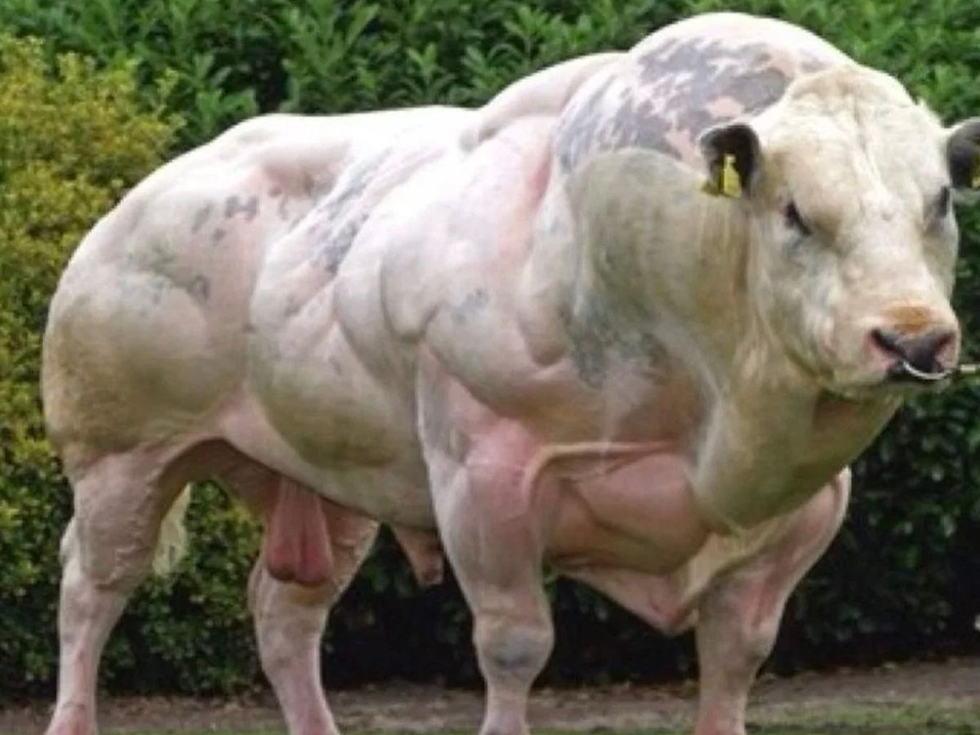
I think my favorite thing has got to the Buff cow mutation. It's not actually called that, but it's really funny just how absurdly buff these cows are.

Double muscled cows have a mutation on the myostatin gene, which interferes with muscle development. Being buff isn't always genetically advantageous, but I'd sure as hell take some myostatin downregulation right now. Myostatin inhibits Akt, a serine-threonine kinase that has a lot of functions (apopotpotposoiss) and stimulating ubiquitin ligases. Ubiquitins mark things in cells to be broken down... like proteins. Essentially, myostatin shows up to degrade muscle protein, but when it has a loss of function mutation, it gives cows gains.
Also, my friend has a Siberian cat named Kite. He is very fluffy and hypoallergenic because he is Siberian. Siberian cats are apparently? Mostly hypoallergenic because they produce less Fel D 1, which is an allergen found in both cat saliva and fur, and the most common cat allergen.
Kite always looks very stressed. Tis silly.

Also! I dissected a harbor seal pup, and it was so cool. It was very bloody, but a very interesting look at their physiology. The pup was a male, and we did have a harder time figuring that bit out, but we were able to figure out the other parts of the body really easily. I got to hold a seal heart, and kidney, and liver!!! SO, so so cool! All the specimens were sourced from South Essex Wildlife Center, and had died of natural causes, which was pretty sad, but RVC is pretty strict about ethics and the like.
It was really cool to see just how dark the muscle was in color (see: myoglobin), and also to see the lobulated liver.

In our third class, developmental biology, we learned a lot about the specific biochemical pathways driving development in pretty much all organisms. We did one really in-depth lesson on fruit fly segmentation genes, which was pretty cool, considering the overlap between those genes and human and other mammalian genes. We did most of our other teaching for this class focused on chick and zebrafish development. Chicks are very easy to visualize, and we have access to chick and zebrafish embryos pretty well. Zebrafish are very clear and also develop very quickly, which makes them a great model for embryological studies.

I think one of the most magical moments I've ever had in lab was the first time I saw the heartbeat of an embryo. It's truly so cool, and one of those moments that sort of reminds you what you're doing it for.

We got to do a lot of work with the zebrafish and chick embryos in practicals (what they call labs here), and I've learned that I would be a shite surgeon. I failed miserably at.. hand eye coordination and just not having shaky hands. Ah well, though.
I really enjoyed the stupid gene names during this class.
Among the most stupid:
Hairy
Sonic hedgehog
sprouty
Hunchback
Giant

I've also read a lot of really cool books, including, but not limited to: Where the Seals Sing, Mistborn: Arcanum Unbounded, Molecular Biology of the Cell, Wheater's Basic Pathology, Marine Mammal Physiology, Pinnipeds of the World, and Black Swan Green. It's been an excellent first term full of microscopy, maggi, and a hell of a lot of learning and just having a generally good time.


Comments