
SEALPOX
- Jan 6
- 2 min read
Tavishi
It's truly shocking that I'm starting off 2026 with a pinniped post, but I read a cool paper about sealpox and I was kind of hooked, especially considering that I'm currently reading about chicken pox in my pathology textbook.
Fun fact: I've never had chicken pox!

I am not someone who could ever really be content studying macro or microbiology; my field of interest really marries the two quite well.
Anyways.
Sealpox is caused by a parapoxvirus, right now classified as Parapoxvirus sealpox. Parapoxviruses tend to be zoonoses just like sealpox, which is spread from pinnipeds to humans via broken skin.

Sealpox was first detected in the Marine Mammal Center in 1986, and has been found to be more populous in rehabilitation environments rather than the wild, generally brought on by the confinement, tight packing, and to some extent, stress of animals. As a whole, stress decreases immune function (see why I always got sick during exam weeks). Sealpox itself isn't that risky an infection; however, the more severe effects of sealpox include secondary disease after initial sealpox infection.

Sealpox, as a parapoxvirus, enters into the cytoplasm of host cells and replicates there. Entry is mediated by glycosaminoglycans, which are these long repeating polysaccharide chains attached to protein chains forming a weird gooey feather structure:

Anyways, glycosaminoglycans permit parapoxviruses like sealpox into the host cell, where the virions release their RNA, where it is transcribed by viral RNA polymerase, and makes all the components necessary to produce more viruses, while borrowing some of the host cell's parts along the way.
Then, sealpox explodes the cell, and virions are released into the body, leaving a trail of dead blownup cells behind.

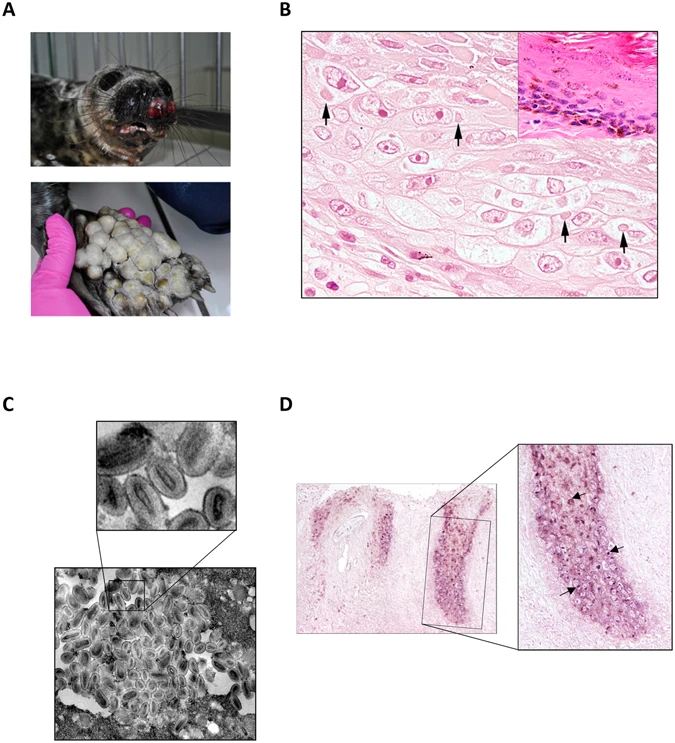
Infection presents differently in humans and pinnipeds. In pinnipeds, sealpox is highly contagious, easily spreading even without open skin. Pinnipeds experience a series of firm nodules which develop after 3-6 weeks of infection. Nodules heal on their own, but often leave scarring.

Humans, on the other hand, are rarely infected by sealpox, unless they were bitten or had open wounds come into contact with sealpox lesion shedding. This is why it's important to wear PPE!!!

In humans, infection comes in the form of one firm nodule developing, rather than several, and is often accompanied by fever and other flu-like symptoms.
Histologically, sealpox can be identified via inclusion bodies and acute inflammation symptoms. Inclusion bodies are accumulations of virus that show up on histology slides. These inclusion bodies can be found either in cytoplasm or outside of cells.
In the case of sealpox, inclusion bodies are eosinophilic (meaning acidic, and showing up staining pink on a H+E stain [go read my histology kradigan]) and intracytoplasmic. These inclusion bodies are less indicative of parapoxvirus, as they are more occasional histological signs.
I would like to go more in depth about histopathology, but this is where y'all stop reading. Next post histo post?!?!?



Comments